December 1903: The Wright Brothers show practical flight is possible
Wilbur and Orville Wright’s quiet achievement in flight demonstrated concepts that would revolutionize aviation.
On the day Wilbur and Orville Wright — two relatively unknown bicycle shop owners — made history with what is now considered the first controlled, powered, human-carrying flight of a heavier-than-air machine, almost no one who heard the news believed, or grasped, that something momentous had happened.
For the fourth year in a row, the brothers traveled to the quiet beaches of Kitty Hawk, North Carolina — a site that provided the open space and strong, steady winds needed for their test flights. On the morning of Dec. 17, 1903, the Wright Flyer took off four times with the help of a roughly 25-mile-per-hour headwind, ascending as high as about 10 feet. The first three flights lasted between 12 and 15 seconds, carrying the craft as far as about 200 feet along the flat sand. On the fourth, Wilbur traveled 852 feet, staying aloft for just under one minute. Soon after landing, the machine was damaged so badly in a sudden gust that it never flew again.
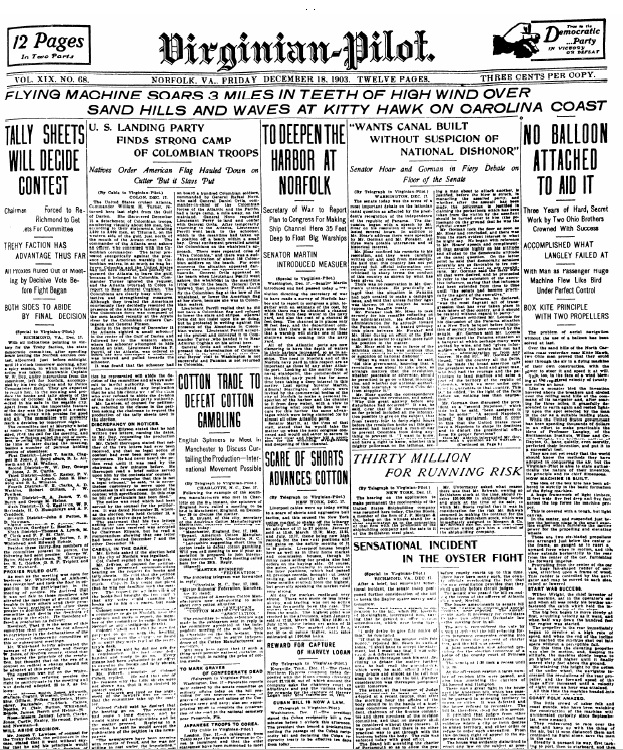
The Wrights weren’t the first, the best known, or the most well-resourced inventors to attempt to fly a human-carrying, engine-powered aircraft. Just nine days before their flights, a team led by Samuel Langley, a renowned astrophysicist and secretary of the Smithsonian Institution, tried and failed to achieve this goal. Backed by more than $50,000 (roughly $2 million today) in mostly government funding and developed over five years, Langley’s Great Aerodrome collapsed and plunged into the Potomac River almost immediately upon launch. Langley’s Dec. 8 failure was still fresh on the day the brothers briefly flew — and with few firsthand witnesses and a fabricated story later claiming they soared three miles, the news was met with skepticism. But to them, their modest success had been a proof of concept for practical flight.
The first Wright Flyer was, in essence, a larger, powered version of the glider the brothers had flown down sand dunes hundreds of times the year before. The pilot lay prone, facing forward, slightly left of center on the lower of its two stacked, muslin-covered wings, which were connected by wooden struts and bicycle spoke wires. When the pilot shifted his hips in a cradle to tug on the wires, the wings warped — like twisting either end of an open spaghetti box — increasing the angle at which one wing met the oncoming wind while decreasing it on the other. The wing at the steeper angle gained lift, allowing the craft to “roll” to bank left or right. That torsion was coupled to the left-right pivot of the rudder, two vertical fins behind the wings that controlled the rotational movement known as yaw — counteracting the unwanted yaw caused by unequal drag on the wings. Out front sat the elevator, two stacked wing-like surfaces that tilted up or down with the pilot’s lever to raise or lower the nose, controlling pitch.
Together, the system allowed the pilot to control movement in all three rotational directions — a combination no one else had achieved. Langley’s Aerodrome had some control over yaw and pitch, but no mechanism for roll. The brothers considered three-axis control so important that in March 1903, nearly nine months before Kitty Hawk, they filed a patent application for it. The application described how to balance and steer an aircraft, but not how to power one.
Langley’s team, after flying an unpiloted, quarter-scale Aerodrome model over 1,000 feet with a roughly 3-horsepower engine, focused on developing an engine with a power-to-weight ratio high enough to carry a full aircraft with a pilot inside — resulting in a sophisticated 52-horsepower engine. The Wrights, meanwhile, struggled to find a manufacturer to produce an engine that met their needs. So they asked their bicycle mechanic, Charlie Taylor. In six weeks, he built a bare-bones engine that produced about 12 horsepower — modest, but more than enough to get the Flyer airborne, the Wrights estimated.
Engine power was useless unless it could be turned into thrust — a forward force that helps the aircraft overcome air resistance, or drag. Earlier aircraft designers had looked to propellers on ships for guidance, but the Wrights found the marine engineering literature unhelpful for designing a propeller suited to air.
The solution came from a tool they’d built for a different purpose. In late 1901, after their second glider’s wings produced much less lift than predicted with existing aerodynamic data — data experts had trusted for decades — the brothers built a small wind tunnel and tested some 200 airfoil shapes. In addition to improving their wing designs, these experiments helped Wilbur see that a propeller was simply a wing spinning on a spiral path. Using their airfoil data and scale model tests, he developed propellers that could produce thrust much more efficiently.
All these pieces worked together on Dec. 17, and the Wrights returned to Dayton, Ohio, confident that they had achieved what they sought to do. They quietly refined their Flyer through 1905, learning to bank, circle, make figure eights, then fly for almost 40 minutes and over 20 miles — finally realizing a machine capable of practical flight. Other inventors were catching up: In 1906, Brazilian aviator Alberto Santos-Dumont flew for about 22 seconds in France. But in 1908, the brothers’ public demonstrations in France and Virginia showed how far they had progressed beyond brief hops.
European builders were quick to adopt and expand the Flyer’s concepts, and the field advanced faster than the Wrights could keep up with it. But their research introduced ideas that would transform aviation. Wind tunnel experiments remain central to the development of wings and propulsion systems, and three-axis flight control systems are standard in airplanes today.
Two months before the flights on Dec. 17, Wilbur sent a letter to Octave Chanute, an engineer and advisor to the brothers. "I see that Langley has had his fling, and failed," he wrote. "It seems to be our turn to throw now, and I wonder what our luck will be." The headwind that morning may have been luck, but the Wrights’ careful, methodical research ensured they made the most of it.
Nyla Husain is the science communications manager at APS.