



September 1905: Einstein's Most Famous Formula
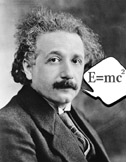 Although several renowned scientists published papers bearing on the theory of special relativity prior to 1900 - including Maxwell, Lorentz and Henri Poincaré - 1905 is generally recognized as the birth year of special relativity. That year saw publication of two important papers on the subject, by an obscure patent clerk named Albert Einstein.
Having failed to obtain a university post teaching mathematics and physics, Einstein was working in the patent office in Bern, Switzerland, when he completed an astonishing range of theoretical physics publications, all written in his spare time without the benefit of close contact with scientific literature or colleagues.
In June, 1905, Einstein proposed what we know today as the special theory of relativity. He based his theory on a reinterpretation of the classical principle of relativity, which postulates that the laws of physics must have the same form in any frame of reference. The theory also assumed that the speed of light remained constant in all frames of reference, as required by Maxwell's theory.
But it was later that year, in a paper received by the Annalen der Physik on September 27, applying his equations to study the motion of a body, that Einstein showed that mass and energy were equivalent, a startling new insight he expressed in a simple formula that became synonymous with his name: E=mc2. However, full confirmation of his theory was slow in coming. It was not until 1933, in Paris, when Irène and Frédéric Joliot-Curie took a photograph showing the conversion of energy into mass, in which a quantum of light carries energy up from beneath and converts into mass in the middle, creating two particles which curve away from each other.
Birthdays for August and September:
August 4: William R. Hamilton (1805)
August 8: Paul Dirac (1902)/E.O. Lawrence (1901)
August 12: Erwin Schödinger (1887)
August 30: Ernest Rutherford (1871)
September 22: Michael Faraday (1791)
September 29: Enrico Fermi (1901)
©1995 - 2024, AMERICAN PHYSICAL SOCIETY
APS encourages the redistribution of the materials included in this newspaper provided that attribution to the source is noted and the materials are not truncated or changed.
Associate Editor: Jennifer Ouellette
August/September 2000 (Volume 9, Number 8)
Articles in this Issue


Information for
About APS
The American Physical Society (APS) is a nonprofit membership organization working to advance the knowledge of physics.
© 2024 American Physical Society | Privacy Policy | Contact Us
1 Physics Ellipse, College Park, MD 20740-3844 | (301) 209-3200