



Foam food for thought. The "Phizz" of foamy food and drink.
 Sid Perkowitz (in between-beer breaks). |
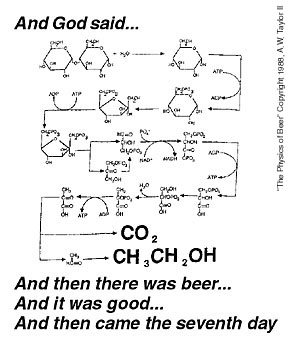
Beer is 'head' food with universal appeal, judging by the physicists and general public alike who crowded into the Georgia Pacific Building auditorium in Atlanta at the end of the hectic, week-long APS Centennial meeting to hear Emory University's Sid Perkowitz. There he elucidated not only the physics of beer, but also of bread, souffles, meringues, mousses, whipped cream (both real and "non-dairy"), cappuccino and latte, marshmallows, champagne, carbonated soda and other foamy food and drink. "There is a lot of science, technology and just sheer human ingenuity that goes into some of these foods, and the techniques employed [to create them] are highly evolved, some dating back thousands of years," said Perkowitz.
Born and raised in New York City, Perkowitz recalls gravitating towards science early on in childhood, an interest fostered by his fascination with the collection of solid state crystals at the Museum of Natural History. "I think science for me was kind of an escape from emotional turmoil, along with reading and other intellectual activity," he says. "It's a way to operate in a world where human messiness doesn't enter in to a certain extent. I wouldn't be surprised if the same were true for other people in the field as well." A graduate of the Polytechnic Institute of Brooklyn, he went on to earn his PhD in solid state physics from the University of Pennsylvania. His research into the physics of solids and liquids and the optical properties of matter resulted in more than 100 papers and a book on the optical characterization of semiconductors.
About ten years ago, Perkowitz embarked upon what has become almost a second career, drawing on his knack for writing about science for the popular readership, which he attributes to being a voracious reader in his youth: "I always said from an early age that although science was definitely my first choice, writing would be my second," he says. He has written for many newspapers and magazines, and authored the book Empire of Light, published in 1996. His latest book for a popular audience is Universal Foam, slated for publication in early 2000, with an entire chapter devoted solely to foamy food and drink. [Watch out Martha Stewart!]
His interest in foamy foods and beverages began when he became intrigued by the complex structure of the bubbles in the foamed milk he made for cappuccino every morning.
A brief sampling of fun foamy facts gleaned from the chapter on edible foams: (1) No-fat, ice cold milk froths the best. (2) Non-dairy aerosol whipped cream contains polysorbate-60 and xanthan gum, both ingredients found in shaving cream. (3) You get a fluffier meringue if you beat the egg whites in a copper bowl. (4) Beers with smaller "heads" of foam actually taste better than those with more aesthetically pleasing larger heads. (5) Beer and bread are closely related; when beer is brewed, it produces a fermenting agent called "barm" as a froth, which is then skimmed off and used to make raised bread. (6) To retain its effervescence the longest, it is best to drink champagne from tall skinny glasses (and, adds Perkowitz, "as often as possible").
He also delivers some fascinating historical trivia with the science. For instance, in 17th century France, the light fluffy bread preferred by the aristocracy was believed to lead the common people (who consumed a solid sourdough bread made without yeast) into "immoral behavior." Ancient Egyptians were baking raised bread as long as 6000 years ago. During the 1800s in America, yeast was also viewed with suspicion until Austrian brewer Charles Fleischmann demonstrated that better bread could be made with yeast. And the first person to make artificial carbonated water was British physicist Joseph Priestley, who unwittingly launched today's multi-billion-dollar soft drink industry as a result.
But the book isn't limited to edible foam. Other chapters cover such diverse topics as the physics and mathematics of soap bubbles, as well as of solid and liquid foams; the puzzling dynamical behavior of bubbles in the phenomenon of sonoluminescence (popularized a few years ago by the film Chain Reaction); biological systems and applications based on bubbles and foam-like geometry, such as insect and fish nests made from foam; bubble-enhanced ultrasound imaging; naturally-occurring pumice and sea foam; and foam technology such as packing peanuts and aerogel, a solid foam constructed from glass and air that serves as an excellent heat insulator, and is already being used on NASA spacecraft.
Should science, writing and beer eventually lose their appeal, Perkowitz has a third alternative career already waiting in the wings. — "a secret desire to be a racing car driver."
 |
©1995 - 2024, AMERICAN PHYSICAL SOCIETY
APS encourages the redistribution of the materials included in this newspaper provided that attribution to the source is noted and the materials are not truncated or changed.
Editor: Barrett H. Ripin
Associate Editor: Jennifer Ouellette
July 1999 (Volume 8, Number 7)
Articles in this Issue


Information for
About APS
The American Physical Society (APS) is a nonprofit membership organization working to advance the knowledge of physics.
© 2024 American Physical Society | Privacy Policy | Contact Us
1 Physics Ellipse, College Park, MD 20740-3844 | (301) 209-3200