


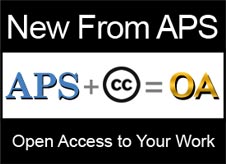
Starting on February 15, APS began a new initiative allowing authors the option to retain copyright and remove access restrictions for papers published in most APS journals. For a fee, authors are able to make their papers open access and available via the Creative Commons Attribution 3.0 license, building upon the current Free-to-Read program. Articles published under this new option can be read without a subscription and reused freely without asking permission.
“This initiative will leave copyright for the articles with the authors. It will allow others to reuse the articles in any way they want, as long as they maintain proper attribution to the original articles,” said APS Treasurer/Publisher Joseph Serene. “We want to be as generous as we can be, as long as that generosity doesn’t have a negative effect on the revenue that allows us to produce high-quality journals.”
The “Free to Read” program allowed anyone free access to read the involved articles, following the payment of a fee (by any interested person). The new initiative, which supersedes “Free to Read,” is different: authors can purchase an agreement that not only allows anyone to read their article, but also, via the Creative Commons License, to freely reuse any part of the article so long as it’s appropriately cited. APS journals continue to have “hybrid” access policies, as some of the articles will be open access while others won’t. The decision to implement the new initiative comes after a careful study of its potential effect on journal income. The fee to take advantage of the new initiative is $1700 for Physical Review A-E and $2700 for Physical Review Letters. Authors are not required to participate in the program and papers that have not had the license purchased for them will be subject to the journals’ standard copyright policies.
“We’ve been thinking about it for a long time and the time finally came and we decided we should do it,” said APS Editor in Chief Gene Sprouse. “A few years ago quite a few authors talked with us about derivative works; they wanted to reuse parts of their articles.” Sprouse added that several scientific agencies, especially in Europe, require papers to be published under free and open access agreements.
Two years ago APS started allowing authors to reuse portions of their articles for derivative works. The policy allows authors to reuse 50 percent or less from a published article. If authors choose the new open access option for an article, they and anyone else will, via the Creative Commons license, be able to reuse any portion of that article for any purpose, as long as the original work is cited.
Creative Commons is a non-profit corporation that provides free licensing agreements to content authors, artists, and other content providers. The Creative Commons Attribution 3.0 license gives anyone the right to freely access, distribute, and adapt the papers as long as the original work is properly credited. The Attribution 3.0 license, also known as CC-BY 3.0, is the most generous license for readers and other users.
APS has been moving to incorporate more free and open-access policies into its journals. Physical Review Special Topics–Accelerators and Beams and Physical Review Special Topics–Physics Education Research started as free access journals, and converted to fully open access journals with the adoption of the new initiative. Articles published in Physical Review X, APS’s newest journal [see story in the February APS News, available online], will also be open access and published under the terms of the CC-BY 3.0 license. In addition, and as a part of a special agreement with CERN, experimental LHC papers are being published similarly.
 Physical Review X
©1995 - 2024, AMERICAN PHYSICAL SOCIETY
APS encourages the redistribution of the materials included in this newspaper provided that attribution to the source is noted and the materials are not truncated or changed.
Editor: Alan Chodos
March 2011 (Volume 20, Number 3)
Articles in this Issue


Information for
About APS
The American Physical Society (APS) is a nonprofit membership organization working to advance the knowledge of physics.
© 2024 American Physical Society | Privacy Policy | Contact Us
1 Physics Ellipse, College Park, MD 20740-3844 | (301) 209-3200