


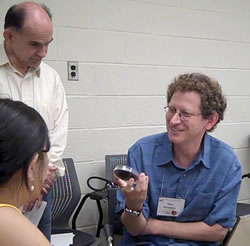

Photo by Elizabeth George
Tom Solomon of Bucknell University demonstrates the simple apparatus needed to create a "blinking vortex flow" used in undergraduate chaotic motion and mixing experiments.
They were attending the Conference on Laboratory Instruction Beyond the First Year of College (or “BFY”), organized by the Advanced Laboratory Physics Association (ALPhA) as a follow-up to the 2009 Topical Conference on Advanced Laboratories that was held at the University of Michigan in Ann Arbor. One of the BFY participants, Ben Stottrup of Augsburg College, noted that “It was great to meet a community of educators who have a passion about experimental physics. I will use ideas I learned in the workshops in my courses this fall.”
“The BFY Conference really illustrated the breadth of hands-on experiments that are being developed for undergraduate physics students. A number of the workshops demonstrated experiments that are well-suited to be offered as in-depth immersion experiences so that faculty and instructional staff can teach the experiments confidently to their own students,” said Lowell McCann of the University of Wisconsin-River Falls. McCann has organized ALPhA’s Laboratory Immersions program, which runs workshops several times a year that provide participants with two to three days of intensive hands-on experience with a single advanced laboratory experiment.
“This conference is an ‛act of community’ and the most efficient way for laboratory instructors to spend the time they devote to revitalizing their courses,” said Conference Chair Gabe Spalding, of Illinois Wesleyan University. The conference was supported by the National Science Foundation, the American Association of Physics Teachers, and the APS Forum on Education. Many equipment vendors also lent their support.
More information about ALPhA can be found at www.advlab.org.
©1995 - 2024, AMERICAN PHYSICAL SOCIETY
APS encourages the redistribution of the materials included in this newspaper provided that attribution to the source is noted and the materials are not truncated or changed.
Editor: Alan Chodos
October 2012 (Volume 21, Number 9)
Articles in this Issue


Information for
About APS
The American Physical Society (APS) is a nonprofit membership organization working to advance the knowledge of physics.
© 2024 American Physical Society | Privacy Policy | Contact Us
1 Physics Ellipse, College Park, MD 20740-3844 | (301) 209-3200