



August/September 2011 (Volume 20, Number 8)
Two Gold and Three Silver Medals for US Physics Olympic Team
By Mary Catherine Adams
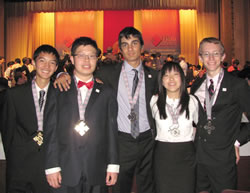

Photo courtesy of Paul Stanley/AAPT
Brian Zhang (left), Ante Qu, Andrew Das Sarma, Lucy Chen and Eric Spieglan represented the U.S. at the 2011 International Physics Olympiad in Bangkok, Thailand. Zhang and Qu both earned gold medals in the competition and Das Sarma, Chen and Spieglan each brought home silver medals.Two of the 5 team members brought home gold medals: Ante Qu, a senior from West Windsor-Plainsboro High School South in Princeton Junction, N.J., and Brian Zhang, a senior from Henry M. Gunn High School in Palo Alto, Calif. Zhang also earned the eighth highest overall score in the competition. To take home a gold medal, a competitor must score 90 percent or better on the exams.
The remaining team members each brought home a silver medal: Lucy Chen, a senior from Ames High School in Ames, Iowa; Andrew Das Sarma, a senior from Montgomery Blair High School in Silver Spring, Md.; and Eric Spieglan, a junior from Naperville North High School, in Naperville, Ill. Das Sarma also earned the second highest score among the silver medal winners.
“We were pleased. We go to the competition hoping to do our best, and we try to instill healthy study habits to help students do that,” Paul Stanley, the team’s senior coach, said.
Gold, silver and bronze medals were awarded to those competitors who scored at least 65 percent on their exams. Her Royal Highness Princess Maha Chakri Sirindhorn, a member of the royal family of Thailand, handed individual medals to around two hundred medal winners at the closing ceremony on the last day of the competition.
This year’s Olympiad took place from July 10–17. The international physics competition for high school students first started in Eastern Europe in 1967 before it grew into a worldwide competition. The U.S. joined the competition in 1986 when three team members won bronze medals, the best debut of any participating team. Though the competition doesn’t rank teams in terms of medal count, if they did, the U.S. would have tied for eleventh place this year.
At the competition, students face exams on a range of physics subjects, answering three theoretical exams and completing two laboratory experiments. This year’s theory question topics included a three-body problem, charged soap bubbles, and Rutherford scattering. The first experiment question required the students to determine the shape of a capacitor and the second had them locating a ball inside a tube. Exams are administered in the students’ native languages and all of the team coaches review the students’ answers to calculate the winners.
The five members of the traveling team were guided by this year’s coaches: Paul Stanley, the academic director and senior coach; Warren Turner, a senior coach and lab coach; Andrew Lin; Jia Jia Dong; Quizi Li; David Fallest; and Marianna Mao. Lin and Mao are both former gold medal winners from previous traveling teams.
The U.S. team is supported by the American Association of Physics Teachers (AAPT), the American Physical Society (APS) and the American Institute of Physics (AIP), along with almost a dozen other AIP member societies.
©1995 - 2024, AMERICAN PHYSICAL SOCIETY
APS encourages the redistribution of the materials included in this newspaper provided that attribution to the source is noted and the materials are not truncated or changed.
Editor: Alan Chodos
August/September 2011 (Volume 20, Number 8)
Articles in this Issue


Information for
About APS
The American Physical Society (APS) is a nonprofit membership organization working to advance the knowledge of physics.
© 2024 American Physical Society | Privacy Policy | Contact Us
1 Physics Ellipse, College Park, MD 20740-3844 | (301) 209-3200