


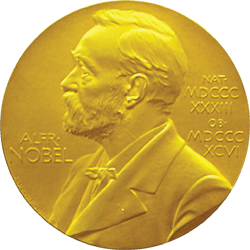
 The Royal Swedish Academy of Sciences awarded the 2009 physics Nobel Prize on October 6th to three researchers for their work developing optics technology integral to the modern information age. Dubbed “The masters of light,” Charles K. Kao won half the prize for his work improving long distance fiber optics, while Willard S. Boyle and George E. Smith shared the other half for developing devices to capture images electronically.
 “This year’s Nobel Prize in Physics is awarded for two scientific achievements that have helped to shape the foundations of today’s networked societies,” the academy said in their announcement, “They have created many practical innovations for everyday life and provided new tools for scientific exploration.”
While working for the British postal service in 1966, Kao developed a critical underlying principle for much of today’s high speed fiber optic cables. At the time, fiber optic cables could only transfer a signal a few tens of meters, but with Kao’s research, cables were soon made to transmit signals over 100 kilometers. He found that transmitting light pulses through the center of an extremely pure glass fiber, rather than along its surface, dramatically reduced signal degradation, allowing for data transfer over much greater distances. Kao shared APS’s James C. McGroddy Prize for New Materials in 1989 for his work developing modern fiber optics.
Boyle and Smith worked at Bell Labs in 1969, originally attempting to design a new memory system that used the photoelectric effect to convert photons into electronic memory. The technology worked poorly to store information, but expanding on their original work, the two researchers soon created “charged-coupled devices” which could easily capture digital images. Within six years of their paper, the two created a video camera with a high enough resolution to be used for TV broadcasts. Today most digital cameras, ranging from small cell phone cameras to the Hubble Space Telescope’s wide field camera, use CCDs to capture images. Boyle is a fellow of the American Physical Society.
“We extend our sincere congratulations to all three Physics Nobel Laureates,” said APS president Cherry Murray, “We are particularly pleased that we can count Boyle among our distinguished APS Fellows, and that the APS had the foresight twenty years ago to honor Kao for his pioneering work on optical fibers. If it weren’t for the contributions of all three of these outstanding physicists, the revolutionary advances in information technology we’ve witnessed in recent decades could never have been possible.”
©1995 - 2024, AMERICAN PHYSICAL SOCIETY
APS encourages the redistribution of the materials included in this newspaper provided that attribution to the source is noted and the materials are not truncated or changed.
Editor: Alan Chodos
November 2009 (Volume 18, Number 10)
Articles in this Issue


Information for
About APS
The American Physical Society (APS) is a nonprofit membership organization working to advance the knowledge of physics.
© 2024 American Physical Society | Privacy Policy | Contact Us
1 Physics Ellipse, College Park, MD 20740-3844 | (301) 209-3200