



Scientists Prove Kansas Flatter than a Pancake
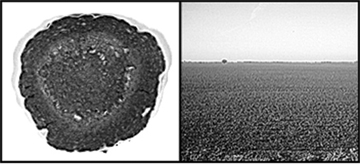  |
The obvious question "How flat is a pancake" sparked their analytical interest, and they set out to find the "flatness" of both a pancake and one particular state: Kansas.
Their findings have been published in the Annals of Improbable Research (AIR) [See link at end.]
Kansans have always fondly claimed that their state, in the heart of America's Great Plains, is "as flat as a pancake." Using modern analytical techniques, geographers Mark Fonstad, William Pugatch, and Brandon Vogt measured the flatness of Kansas, and contrasted it with the flatness of a pancake.
Their results demonstrate that, of the two, Kansas is considerably flatter. [It may also be of significance that the town of Liberal, Kansas, hosts the annual "International Pancake Day" festival.]
Barring the acquisition of either a Kansas-sized pancake or a pancake-sized Kansas, mathematical techniques were needed to do a proper comparison.
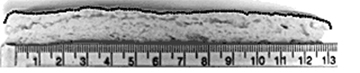
The scientists compared the two surfaces?Kansas and the pancake?using special geographic information software. Topographic elevation data for Kansas was taken from a digital scale model prepared by the United States Geological Survey.
The pancake was purchased from an International House of Pancakes. "The importance of this research dictated that we not be daunted by the 'No Food or Drink' sign posted in the microscopy room," write the authors.
One common method of quantifying "flatness" in geodesy is the "flattening" ratio. The length of an ellipse's (or arc's) semimajor axis (a) is compared with its measured semiminor axis (b) using the formula for flattening. A perfectly flat surface will have a flattening of one, whereas an ellipsoid with equal axis lengths will have no flattening, and f will equal zero. For example, the earth is slightly flattened at the poles due to the earth 's rotation, making its semimajor axis slightly longer than its semiminor axis, giving a global f of 0.00335.
How flat is Kansas, compared to a pancake? Fonstad, Pugatch, and Vogt explain that:
Mathematically, a value of 1.000 would indicate perfect, platonic flatness. The calculated flatness of the pancake transect is approximately 0.957, which is pretty flat, but far from perfectly flat.
After many hours of programming work, we were able to estimate that Kansas's flatness is approximately 0.9997. That degree of flatness might be described, mathematically, as "damn flat."
For the complete online article, see http://www.improbable.com/airchives/paperair/volume9/v9i3/kansas.html
©1995 - 2024, AMERICAN PHYSICAL SOCIETY
APS encourages the redistribution of the materials included in this newspaper provided that attribution to the source is noted and the materials are not truncated or changed.
Associate Editor: Jennifer Ouellette
October 2003 (Volume 12, Number 10)
Articles in this Issue


Information for
About APS
The American Physical Society (APS) is a nonprofit membership organization working to advance the knowledge of physics.
© 2024 American Physical Society | Privacy Policy | Contact Us
1 Physics Ellipse, College Park, MD 20740-3844 | (301) 209-3200