



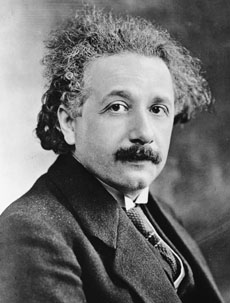
 Albert Einstein Photo courtesy of AIP Niels Bohr Library |
Born in Germany in 1879, Einstein is notorious for having been expelled by a headmaster as a young school boy. He went on to win the 1921 Nobel Prize in physics for uncovering the theory of the photo-electric effect. His early work on the fundamentals of quantum theory and, of course, relativity, laid the groundwork for much of modern physics. This in turn paved the way for an unprecedented degree of technological development, including nuclear fission and fusion - the basis for the atomic bomb, nuclear power, and solar energy. Einstein emigrated to the US in 1933 to take a post at the Institute for Advanced Study, Princeton, NJ, narrowly escaping persecution by the Nazi government because of his Jewish heritage. He has since become one of the most recognizable faces in American physics, and has even been immortalized on the Silver Screen by actor Walter Matthau in the popular romantic comedy, I.Q
In announcing their selection, the magazine editors wrote, "In a century that will be remembered foremost for its science and technology - in particular for our ability to understand and then harness the forces of the atom and the universe - one person clearly stands out as both the greatest mind and paramount icon of our age: The kindly, absent-minded professor whose wild halo of hair, piercing eyes, engaging humanity and extraordinary brilliance made his face a symbol and his name a synonym for genius."
More information about Einstein can be found at websites: www.aip.org/history and www.pbs.org/wgbh/nova/einstein<.
©1995 - 2024, AMERICAN PHYSICAL SOCIETY
APS encourages the redistribution of the materials included in this newspaper provided that attribution to the source is noted and the materials are not truncated or changed.
Associate Editor: Jennifer Ouellette
February 2000 (Volume 9, Number 2)
Articles in this Issue


Information for
About APS
The American Physical Society (APS) is a nonprofit membership organization working to advance the knowledge of physics.
© 2024 American Physical Society | Privacy Policy | Contact Us
1 Physics Ellipse, College Park, MD 20740-3844 | (301) 209-3200