



August/September 1998 (Volume 7, Number 8)
Coulomb Interactions, "Transistor-less Computing" Highlight 1998 DAMOP Meeting
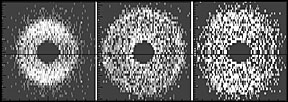 The doughnut-shaped images above provide information on the alignment of a helium hydride ion (HeH+) as it collides with a target of helium atoms, captures an electron, and becomes a neutral HeH molecule. Three cases are shown: collisions producing HeH in its lowest energy state (left), in an excited state (center), and a higher-energy excited state (right). |
Recent studies on Coulomb interactions of hydrogen atoms and the relative masses of protons and antiprotons, as well as the possibility of transistor-less computing using arrays of quantum dots, were among the highlights of the 29th annual meeting of the APS Division of Atomic, Molecular and Optical Physics (DAMOP). Held jointly with the AMO division of the Canadian Association of Physicists, the conference took place from 27-30 May 1998 in Santa Fe, New Mexico.
Wednesday's opening plenary session featured lectures from this year's recipients of the Davisson-Germer, Earle K. Plyler and Will Allis Prizes, while two of the winners of the 1997 Nobel Prize in Physics - Steven Chu (Stanford University) and William Phillips (NIST) - were featured at Saturday's closing plenary session. There was also a special session featuring papers presented by finalists for the DAMOP Thesis Award and for undergraduate research (see stories, page 5).
Protons and Antiprotons Have Same Mass. Protons and antiprotons have the same mass to within one part in 10 billion, according to Harvard physicists Gerald Gabrielse and Anton Khabbaz. Along with their Bonn collaborators, they are able to make this comparison by loading a single antiproton and a single proton (saddled with two electrons, in order to make the proton into a negatively charged object) and letting them orbit simultaneously around an ion trap under the influence of a strong magnetic field. This stringent new measurement constitutes the best test yet (by a factor of 10) of the CPT theorem, which says that physics should not discriminate between particles, and antiparticles moving backwards in time.
Record Low Temperatures for Elementary Particles. In a separate ion trap experiment, Gabrielse and his Harvard colleagues chilled electrons down to only 70x mK, making this the first time elementary particles had ever been stored at temperatures below 4x K; previously only atoms, which are much heavier composite structures, had been cooled so low.
Coulomb Interactions of Hydrogen Ions. How three hydrogen ions share their energy and how they position themselves with respect to each other has been experimentally measured for the first time, shedding light on the infamous "three-body problem" in the realm of electrically charged particles.
Previous experiments with two electrons and a positive ion can be easily approximated as a two-body problem because the ion remains relatively stationary. Lisa Wiese of the University of Nebraska described smashing a molecular ion H3+ against a helium target to produce three ions: H+, H-, and H+. The target, the physicists deduced that the H- tended to reside in between the two H+ ions, from near the "Coulomb saddle point" (where the forces from the other hydrogen ions balance out) to the near vicinity of an H+ ion. Interestingly, the H- was never found at the saddle point itself.
Transistor-Less Computing. Quantum dot cellular automata (QCA) might make possible a new type of transistor-less computing. A quantum dot is essentially a zero-dimensional artificial atom, isolated on (or in) a semiconductor substrate. Using a pair of electrons within a cell of four closely spaced dots - the electrons can tunnel from dot to dot - creates a binary bit: the configuration of the electrons establishes either a 1 or a 0. Put many of these cells together and you have a programmable cellular automata network. Wolfgang Porod at Notre Dame reported on the modeling and operation of a QCA array, including a demonstration of the manipulation of a single electron by another nearby single electron.
Momentum Microscope. A momentum microscope for viewing single-molecule collisions has been demonstrated, allowing physicists to determine how the alignment of a molecule can affect the final outcome of a collision. Michael Prior of Lawrence Berkeley Lab described how he and his colleagues combined the imaging of molecular fragments with a new application of the technique called COLTRIMS, short for "cold target recoil ion momentum spectroscopy." COLTRIMS collects the products of a collision in a weak electric field and projects them onto position-sensitive detectors. Measuring the particles' positions and the times it takes them to fly to the detector, one can determine the particles' momentum values and thereby reconstruct the collision itself.
Optical Force Clamps for Molecular Motors. Scientists at Princeton University have developed a novel optical trapping microscope, or force clamp, to better enable the study of single molecules of kinesin, a motor protein. According to Koen Visscher, the optical force clamp specifically permits investigation of the long-standing question of how mechanical motion is coupled to the biochemical engine cycle. "The combination of new optical trapping and statistical analysis techniques opens new and powerful ways of studying protein dynamics at the single molecule level in a wide variety of systems," said Visscher.
Spin-Polarized Noble Gases. The ability to polarize large quantities of noble gases such as He3 and Xe129 is emerging as a powerful tool for probing the spin structure of the neutron in particle and nuclear physics, according to Princeton's Gordon Cates, who reviewed recent progress in spin-exchange optical pumping to create large nuclear spin polarizations in dense samples of noble gases, as well as some potential applications. Such large spin-polarization greatly enhances the NMR detection sensitivity of these gases. Genevieve Tastevin of the Ecole Normale Superieure in France recently obtained high resolution 3-D images of ventilatory lung spaces in humans by nuclear magnetic resonance using inhaled hyperpolarized He3 gas.
©1995 - 2024, AMERICAN PHYSICAL SOCIETY
APS encourages the redistribution of the materials included in this newspaper provided that attribution to the source is noted and the materials are not truncated or changed.
August/September 1998 (Volume 7, Number 8)
Articles in this Issue


Information for
About APS
The American Physical Society (APS) is a nonprofit membership organization working to advance the knowledge of physics.
© 2024 American Physical Society | Privacy Policy | Contact Us
1 Physics Ellipse, College Park, MD 20740-3844 | (301) 209-3200