
American Physical Society
American Physical Society Sites|APS|Journals|PhysicsCentral|Physics
 
Login| Become a Member|Contact Us
  • Publications
    • Journals of the American Physical Society
    • APS News
    • Physics
    • Physics Today
    • Capitol Hill Quarterly
    • Other APS Publications
    • Reciprocal Society Newsletters
  • Meetings & Events
    • March Meeting
    • April Meeting
    • Meeting Calendar
    • Abstract Submission
    • Archives of the Bulletin of the American Physical Society
    • Policies & Guidelines
    • Meeting Presentations
    • Virtual Press Rooms
  • Programs
    • Education
    • International Affairs
    • Physics Outreach
    • Women in Physics
    • Minorities in Physics
    • Prizes, Awards & Fellows
  • Membership
    • Join APS
    • Renew Membership
    • Member Directory
    • My Member Profile
    • Member Services
    • APS Units
  • Policy & Advocacy
    • Issues
    • Reports & Studies
    • APS Statements
    • Advocacy Tools
    • Advocacy Resources
    • Fellowships & Fellows
    • Contact APS Public Affairs
  • Careers In Physics
    • Physics Jobs
    • Becoming a Physicist
    • Career Guidance
    • Physics Careers Statistical Data
  • About APS
    • Mission Statement
    • Society Governance
    • Society History
    • Donate to APS
    • APS Jobs
    • Contact Us
Programs
  • Education
  • International Affairs
  • Physics Outreach
  • Women in Physics
  • Minorities in Physics
  • Prizes, Awards & Fellows
    • Prizes
    • Awards, Medals & Lectureships
    • Dissertation Awards
    • APS Fellows
    • Other APS Scholarships, Lectureships & Fellowships

Email Email   Print Print     Share Share
 
Home   |   Programs   |   Prizes, Awards and Fellowships   |   Prizes   |   Prize Recipient

Prize Recipient


Alicea

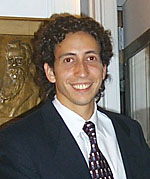
Jason Alicea
University of Florida

Citation:

"Resistance of multilayers with long length scale interfacial roughness."

Background:

Alicea's thesis centered on finding a theoretical explanation for these unusual experimental results by carrying out the numerical solution of the Boltzmann transport equation. He first found that the long length scale interfacial roughness decreased resistance when the current was flowing perpendicular to the layers-the opposite of the UCSD experimental results. He then tried the short mean free path limit, and found that the resistance increased with interfacial roughness when the current flows either perpendicular or parallel to the layers, just as the UCSD researchers observed. In his manuscript, Alicea carefully addressed the question of which parameter regime one needs in order to see a resistance increase, decrease or no change at all, and these well-defined calculations will help guide future work.

Home | APS Jobs | Media Center | Terms of Use | Site Map

Follow APS: Feeds Facebook LinkedIn Wordpress Twitter Google Plus YouTube

© 2013 American Physical Society