

Prize Recipient
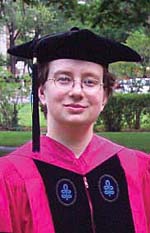
Nadia Lapusta
Harvard University
Citation:" For work on an innovative computational algorithm to simulate sequences of earthquake instabilities spanning more than ten orders of magnitude in time with physical representations of friction and rigorous continuum elastodynamics, leading to elucidation of earthquake nucleation, seismic radiation, and small-event clustering processes.
Nadia Lapusta was born in Ukraine. She graduated with highest honors from the Department of Mechanics and Mathematics at Kiev State University in 1994. Her education continued in the Division of Engineering and Applied Sciences at Harvard University, where she got her Ph.D. in Engineering Sciences in 2001. Currently, Nadia is a Postdoctoral Fellow in the same Division. She received an Outstanding Student Paper Award from the American Geophysical Society in 1998 and a Certificate of Distinction in Teaching from Harvard University in 1999.
In her Ph.D. research under the guidance of Prof. Rice, Nadia developed and used computational and analytical approaches to study elastodynamic frictional sliding. She investigated stability properties of friction laws, spatio-temporal patterns of slip in multi-scale simulations, and connections between them. That work provided new perspectives on the physics of earthquakes, including the process of earthquake nucleation, irregularities in the earliest phases of seismic radiation, clustering of small events at rheological transitions, and modes of dynamic rupture propagation.
Selection Committee:
Bruce Ira Cohen (Chair), Bruce Berne, David Ceperley, Steve Louie, Bob Rosner, Doug Toussaint


Information for
About APS
The American Physical Society (APS) is a nonprofit membership organization working to advance the knowledge of physics.
© 2024 American Physical Society | Privacy Policy | Contact Us
1 Physics Ellipse, College Park, MD 20740-3844 | (301) 209-3200